
jellyfish
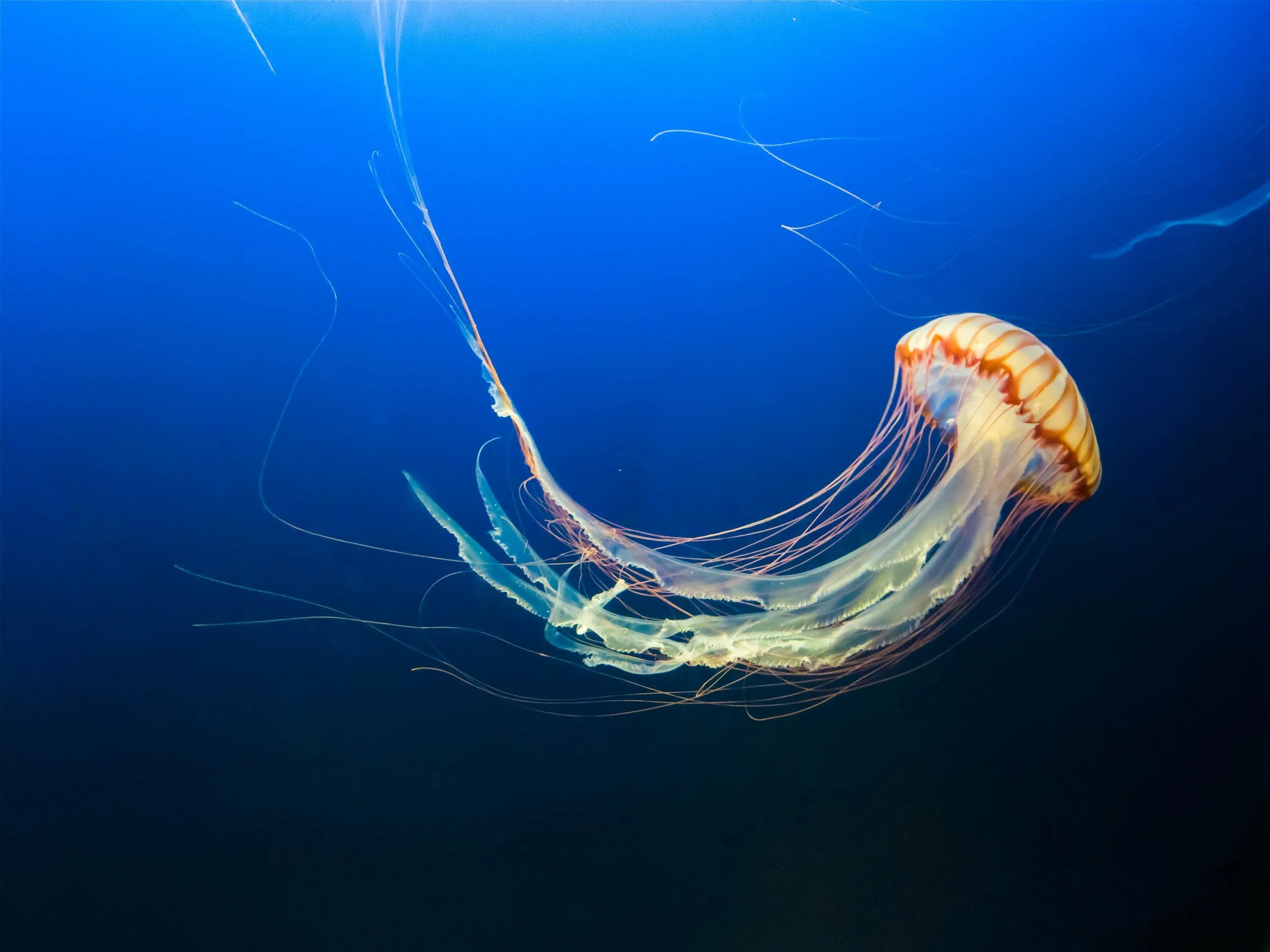
Jeffrey Hamilton/Unsplash
Jellyfish are invertebrates (without a backbone), made of nearly 95% water and can be found everywhere, in shallow and deep water, from the tropics to the poles. Although their lifespan is usually short - most live for only a few weeks, some for a few hours, others for a few years - they have been around for more than 500 million years. Their 2 to 200 cm bell-shaped bodies are curved, their mouths, four oral arms and tentacles are on the underside. With no brain, heart or lungs, their nervous system (known as a nerve net) allows them to smell and detect light, temperature, chemical changes, food or danger in the water while their radial symmetry means that they can do so from any direction. Their bodies consist of three layers: the outer layer or epidermis, middle layer (this is the jelly-like substance whcih gives them their name) called mesoglea; and an inner layer, the gastrodermis whcih lines the gut cavity and helps them digest food and absorb nutrients, using just one opening for both the mouth and the anus. Jellyfish either drift with the ocean currents or propel themselves along by contracting their muscles and squirting water in the opposite direction from where they want to go.
Named after the Greek for sea nettle, jellyfish have tiny cells on their tentacles called nematocysts which they use to stun or paralyze their prey before the oral arms are used to pass the food to the jellyfish’s mouth. They feed mainly on fish larvae, shrimp, crustaceans such as krill and copepods, small shrimp-like organisms called amphipods and tiny plants such as algae. Predators of jellyfish include the ocean sunfish, grey triggerfish, turtles, some seabirds such as fulmars, whale sharks, arrow and hermit crabs and humpbacks.
Jellyfish usually drift alone although jellyfish blooms can occur after an explosion in a jellyfish population, caused by the removal of natural predators through overfishing or through higher levels of nutrients (made available through runoff) attracting greater accumulations and breeding.